Our Services

Web Development
Services

Build high-performance web applications that convert and scale. We combine technical excellence with cutting to turn complex business requirements into polished digital experience.

Skilled
Development Team
3
Continents Served
20+
Technologies Supported
Flexible
Engagement Models

What We Do

At IDOWS Apex, we don’t just build custom applications, we engineer digital ecosystems. Our team provides premium web development services, building secure, fast, and highly scalable applications. By leveraging modern frameworks like React, Next.js, and Node.js, we deliver digital experiences to empower your business growth through architectural integrity.

What We Build

Premium web applications across every architecture. From static sites to dynamic enterprise portals, we deliver apps that are built for speed, scale, and long-term maintainability.

Single Page Applications (SPA)

At IDOWS Apex, we build lightning-fast SPAs using React and Vue that deliver app-like experiences in the browser. Our focus on client-side routing and optimistic updates ensures your applications are instantaneous, even on slower connections.

Progressive Web Apps (PWA)

We help you extend your reach by building the best Progressive Web Applications (PWA) that ensure offline capabilities, push notifications, and installable experiences. Utilizing advanced caching strategies and service workers, we ensure your app remains equally functional in offline environments.

Server-Side Rendered Sites (SSR)

Using Next.js, we prioritize sub-second latency via Time to First Byte (TTFB) and First Contentful Paint (FCP). By executing data fetching on the server, we improve SEO crawlability and ensure users receive populated HTML, reducing load on Client devices.

Static Site Generation (SSG)

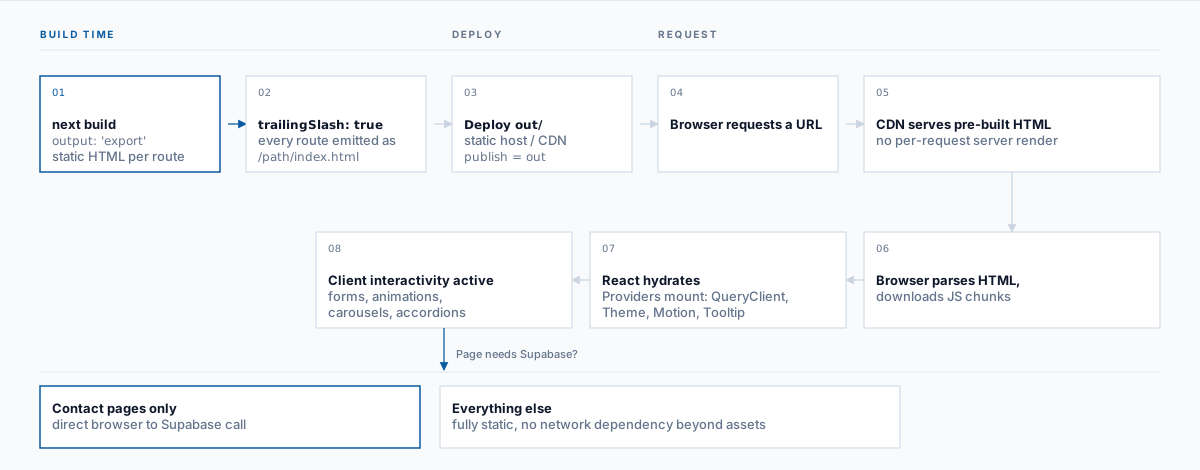
We use Jamstack architecture to build ultra-secure websites that are content-heavy, ultra-secure, and responsive. By pre-rendering pages and serving them from a global CDN, we reduce server overheads and ensure your site stays online during traffic spikes.

Enterprise Web Portals

We design and build large-scale web portals - from B2B SaaS dashboards to employee intranets and customer self-service platforms. Our portals handle complex authentication, role-based access, and multi-tenant data isolation at enterprise scale.

Custom E-commerce Platforms

Beyond generic Shopify themes, we build bespoke e-commerce experiences with custom checkout flows, real-time inventory, and headless CMS integrations. Our platforms are optimized for conversion, performance, and seamless ops integration.

Content Management Systems

We build and integrate custom headless CMS solutions using Sanity, Contentful, and Strapi that give your team full editorial control without developer involvement. Structured content powers web, mobile, and any future channel from one source.

Full-Stack Web Engineering

End-to-end ownership from database schema to pixel-perfect UI. Our full-stack engineers write clean, type-safe code across the entire application layer - TypeScript, REST, GraphQL, and Node.js powered backends - with deployment pipelines included.

Cloud-Native Web Applications

We architect web applications designed for infinite scale from day one - serverless functions, edge-deployed middleware, and auto-scaling APIs. Your infrastructure costs stay near zero at low traffic and scale automatically as your user base grows.

Why Choose Us

Why brands trust IDOWS Apex for their core web products

01

Conversion Focus

Websites designed not just to look good, but to drive measurable business results.

02

Future-Proof Tech

We use modern, supported technologies that won't be obsolete in two years.

03

SEO Optimized

Best-in-class technical SEO built directly into your application's architecture.

04

Fast Delivery

Agile methodologies that deliver value to your users sooner rather than later.

05

Ongoing Support

We're your long-term partner, providing maintenance and feature updates after launch.

06

Clean Codebase

Maintainable code that your team (or ours) can easily scale in the future.
Our Web Development Process

A structured, quality-first approach that takes your idea from architecture to production with zero surprises.

1

Discover & Architect

  • Requirements analysis & tech roadmap
  • Performance & SEO strategy
  • Component architecture design
  • Database schema & API planning
2

Design & Engineer

  • Wireframing & UI/UX design
  • Frontend & backend development
  • Third-party API integrations
  • Unit & integration testing
3

Launch & Maintain

  • Cross-browser & device testing
  • Production deployment & CDN setup
  • Performance monitoring & alerting
  • Ongoing feature development

Modern Web Stack

Engineering depth across the modern JavaScript and full-stack ecosystem

Architecture Decision

Choosing How a Web App Renders

The rendering model is the first architectural decision on a web project and the most expensive one to reverse. It determines indexability, first-load speed, and hosting cost. There is no default answer - it follows from how your content changes.

Server-rendered (SSR)

Use when: Content must be current per request and indexable - catalogues that change through the day, anything personalised.

Trade-off: Needs a running server and a caching strategy; costs more to operate than static.

Static generation (SSG)

Use when: Content changes on a publish cycle rather than per request - marketing sites, documentation, guides.

Trade-off: Fastest and cheapest to serve. Rebuild time grows with page count.

Single-page application (SPA)

Use when: The interface is an application rather than a set of pages - editors, consoles, tools used for long sessions.

Trade-off: Weakest for indexing and first-load speed unless paired with server rendering.

Hybrid

Use when: Most real applications: a static marketing surface, a server-rendered catalogue, and a client-rendered account area in one codebase.

Trade-off: Requires deliberate boundaries so the routing model stays comprehensible.

We work primarily in the React and Next.js ecosystem, which supports all four models in one application - see JavaScript development for that stack in depth. Where a project is better served by a PHP application or an existing WordPress estate, we build there instead: PHP and Laravel and WordPress development.

Engineering Scope

Frontend, Backend, and What Joins Them

A common question at the first call is whether we build the backend or only the interface. We build both, and in most projects the backend and data work is the larger half.

Frontend engineering

Component architecture, state management, routing, and the accessibility and performance work that decides whether an interface is usable on a mid-range phone.

Backend and APIs

We build the server side, not only the interface - application logic, authentication, background jobs, and the API the frontend consumes.

Data layer

Schema design, query performance, migrations, and caching. Most 'the site is slow' reports resolve to a query pattern rather than the frontend.

Delivery pipeline

Build, test, and deploy automated so a release is routine, with environments defined in code and a rollback that has actually been exercised.

Connecting to the Rest of the Business

Very few web applications are self-contained. Most need to read from or write to something else - a CRM, an ERP, a payment provider, an internal service - and that traffic is where reliability problems concentrate. We treat each integration as an interface with its own error handling, retry behaviour, and defined answer to what happens when the other side is unavailable.

Where a system has no usable API, the interface has to be built before the application can rely on it. That is scoped as integration work in its own right rather than absorbed silently into a web build estimate.

Modern Web Engineering

The Non-Negotiables

These four are cheap to design in and expensive to add later, which is the whole argument for treating them as requirements rather than enhancements.

Performance

Budgets set at design time and measured in the pipeline - bundle size, image handling, and the render path that determines perceived speed. We measure rather than promise a score.

Accessibility

Semantic markup, keyboard operability, focus management, and contrast handled during the build. Retrofitting accessibility after launch costs several times more than designing for it.

Security

Input validation, authentication and session handling, dependency monitoring, and secrets kept out of the codebase - built in rather than added before go-live.

Maintainability

Typed interfaces, tested critical paths, and conventions a developer who did not write the code can follow. This is what makes year three affordable.

Independent verification of the above is software testing and QA, and the infrastructure it runs on is cloud development.

If You Are Building a Store

Selling online is a web project with an extra decision in front of it: whether to build on a commerce platform or engineer the storefront yourself. That decision usually matters more than the frontend framework, because the platform sets your data model, your checkout, and what you are permitted to customise.

We have written that comparison up separately rather than duplicating it here - our ecommerce development guide covers platform selection, migration, and integrations, and links through to the platform builds themselves. If the requirement is a store rather than a web application, start there.

Web Development in Context

This page is about engineering the application. The question of whether bespoke software is the right answer at all - against buying a product or configuring a platform - is covered under custom software development. If you need to validate the idea before committing to a full build, that is MVP development.

Where the same product also needs to reach users off the web, see mobile development - and where an installable, offline-capable web experience is a better fit than a native app, progressive web apps is the middle path.

Insights & Updates

Latest Insights& Technical Updates

Deep technical analysis, architectural case studies, and strategic perspectives from our senior development teams.

Frequently Asked Questions

Ready to Get Started?

Let's discuss your project and see how we can help you achieve your goals.

Expand Your Reach

Discover More Services

Explore our complementary expertise to accelerate your digital transformation journey.