Build vs. Buy: When Does Custom Software Actually Make Sense?
Every growing business faces the same decision: buy off-the-shelf or build custom? It's a strategic choice with massive consequences for your bottom line.
A practical guide to eCommerce development - choosing the right platform, planning a custom build, and the integrations that turn a storefront into a real sales channel.
eCommerce development covers more ground than picking a platform and installing a theme. It spans platform selection, custom storefront and checkout engineering, catalog and inventory architecture, and the integrations that connect your store to payments, fulfillment, and the rest of your operational stack. This guide walks through how IDOWS Apex approaches each stage, and points to the specific platform and service pages relevant to your build.
What separates storefronts that convert from storefronts that just look good
We build on Shopify, Magento, OpenCart, and Wix, and recommend based on your catalog and growth plan - not whichever platform we happen to specialize in.
Every storefront decision is evaluated against checkout friction and page speed, because a beautiful store that loads slowly loses more revenue than a plain one that loads fast.
Platform migrations include a full URL redirect map and historical data transfer, so you keep the search rankings and backlinks you've already earned.
We build storefronts assuming they'll need to talk to an ERP, CRM, or marketing platform eventually - not as an afterthought once the first integration request comes in.
When a platform's data model genuinely can't support your pricing or fulfillment logic, we build custom rather than forcing your business into a workaround.
We stay on after launch for platform upgrades, security patching, and seasonal traffic scaling, so peak sales periods don't become incident response drills.
A methodical approach to delivering high-performance digital solutions.
We evaluate your product catalog complexity, pricing logic, and fulfillment workflow to determine whether a platform build or custom development is the right fit.
Where a platform makes sense, we match Shopify, Magento, OpenCart, or Wix against your catalog size, B2B needs, and existing tooling rather than defaulting to the most popular option.
We design the browsing, product, and checkout experience around conversion - minimizing friction at every step where a customer could abandon a purchase.
Development covers the storefront itself plus the integrations that make it operational: payments, tax, shipping, inventory sync, and CRM or ERP connections.
For existing stores, we execute the platform migration with a full redirect map and data transfer so search rankings and customer history carry over intact.
Post-launch, we monitor page speed and checkout conversion, treating both as revenue metrics worth continuous testing rather than one-time launch checkboxes.
The platforms and tooling behind every storefront we build
No platform is best in general - each trades control against operational burden differently. What follows is where each one genuinely fits, including where it stops fitting. We build on all six, which is why we are comfortable pointing you away from any of them.
| Platform | Best fit | Main strength | Main limitation |
|---|---|---|---|
| Shopify | Fast-growing DTC brands wanting managed infrastructure | Hosting, security patching and PCI scope handled for you; large app ecosystem | Checkout customization is constrained below Shopify Plus; platform fees scale with revenue |
| Magento | Large catalogs, B2B pricing, multi-store or multi-currency | Deepest native B2B and catalog modelling of the mainstream platforms | Highest operational and hosting burden; needs real infrastructure attention |
| WooCommerce | Teams already on WordPress, or wanting full code ownership | Open source and self-hosted; no transaction fees; unlimited customization via hooks | You own hosting, updates and performance work that a hosted platform absorbs |
| OpenCart | Cost-conscious catalogs wanting self-hosted flexibility | Lightweight, straightforward to extend, low licensing overhead | Smaller ecosystem and community than the larger platforms |
| Odoo | Businesses wanting commerce inside a wider ERP | Store shares one data model with inventory, accounting and CRM | Weaker as a pure storefront than dedicated commerce platforms |
| Wix | Smaller catalogs prioritising speed of setup and content | Fastest route to a presentable, content-led store | Outgrown quickly by complex catalogs or unusual commerce logic |
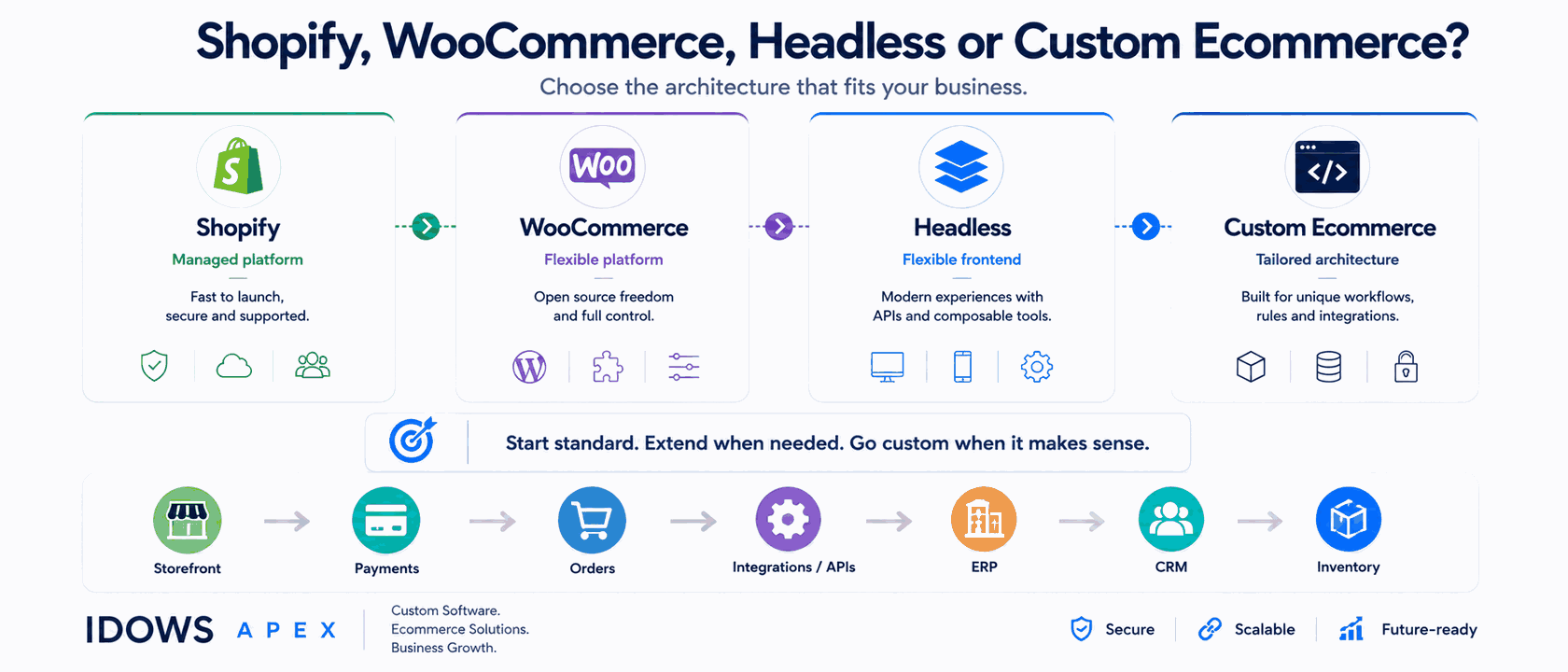
Custom commerce work becomes justified in a few specific situations: when pricing or fulfillment rules cannot be expressed in any platform's data model, when a quote-to-order or approval workflow spans several systems, or when transaction volume makes platform fees a material line item rather than a rounding error.
It rarely means replacing the whole store. The more common pattern is a platform storefront with a custom service handling the part it cannot - a pricing engine, an allocation service, a partner-facing ordering portal - integrated behind the checkout the customer sees. That keeps the undifferentiated work on the platform and puts the engineering effort where it earns something.
Where that service becomes the substance of the project, it is custom software development - and the question of whether to build at all is worked through there. We have also written up the decision itself in detail: when to choose custom ecommerce over Shopify or WooCommerce.
Integration scope is usually the largest single driver of an ecommerce budget, and the part most often underestimated at quoting time.
Gateway integration, and tax calculation that reflects where you actually sell. Getting tax wrong is a compliance problem, not a feature gap.
Stock synchronization between the store and the system of record, including who wins when the two disagree - the question most integrations skip and later regret.
Customer and order data flowing into the tools your marketing team already uses, so segmentation reflects real purchase behaviour.
Rate calculation at checkout, label generation, and status updates back to the customer from the carrier or 3PL.
Conversion and revenue tracking wired in deliberately, with consent handling, rather than assembled from whatever tags accumulated over time.
Everything the categories above do not cover - pricing services, loyalty schemes, partner feeds - built as interfaces with their own error handling.
The engineering behind these connections is our integrations practice; where the upstream system is an ERP, see ERP development.
Replatforming is mostly a data and URL exercise. The build is rarely what goes wrong.
The single highest-risk item. Product, category and content URLs need a complete redirect map, or existing rankings and inbound links are lost at cutover.
Variations, attributes and media rarely map one-to-one between platforms. The mapping is decided before anything moves, not discovered during it.
Accounts transfer, but password hashes usually cannot. Plan the reset communication as part of launch rather than as a surprise.
Historical orders matter for support, returns and accounting. Decide early whether they migrate fully or are archived for reference.
Every connected system needs re-pointing and re-testing. This is routinely underestimated and is where most migration overruns originate.
A staged rehearsal against real data, with a rollback path, before the DNS change - not a switch-over date and optimism.
Commerce performance is diagnosable rather than mysterious. We profile before changing anything, because the fix for a slow catalog page is not the fix for a slow checkout.
Image formats and sizing, script discipline, and the render path for category and product pages, where most stores lose their speed.
Catalog and order tables grow fast. Indexing and query work on the busiest paths usually gives the largest gain.
Page, object and edge caching, applied carefully so carts, accounts and customer-specific pricing never enter a shared cache.
Scheduling and batching synchronization traffic so a stock update job does not compete with shoppers for the same resources.
Where most of your traffic is mobile and the storefront is used repeatedly rather than once, a progressive web app is worth weighing against a native app. It gives installability, offline-tolerant browsing and push notification support from the same codebase as the web store, without app-store distribution.
It is not automatically the right answer - it adds build complexity, and a well-optimised mobile store often performs comparably. See progressive web apps for how we assess the trade-off, and mobile development where a native application is genuinely warranted.
"eCommerce development" spans a much wider range of work than most businesses expect going in. At one end, it's picking a platform and configuring a theme - a project measured in weeks. At the other, it's a fully custom commerce engine with bespoke pricing logic, multi-warehouse fulfillment, and deep ERP integration - a project measured in months. Knowing which end of that spectrum your business actually needs is the difference between a store that ships on budget and one that either overspends on custom work it didn't need or under-delivers on a platform that can't support the business model.
For most catalogs, a platform is the right call. Shopify, Magento, OpenCart, and Wix each handle the undifferentiated heavy lifting - hosting, payment security, checkout compliance - so your team's effort goes into the product and customer experience instead of infrastructure. The right platform among those four depends less on feature checklists than on your catalog's complexity, your B2B or multi-currency needs, and how deeply you need to customize checkout and pricing logic. Custom development earns its cost only when a platform's underlying data model genuinely can't represent how your business actually sells - complex tiered pricing, unusual fulfillment splits, or a checkout flow no platform's app ecosystem can replicate.
Whichever path fits, a storefront is rarely the whole project. Payment and tax integrations are table stakes; inventory sync with a warehouse or ERP system, CRM connections for customer data, and marketing platform integrations are what turn a storefront into an operational sales channel instead of an isolated website. And if you're migrating an existing store, preserving your SEO rankings and order history through that migration matters as much as the new platform's feature set. The sections below cover our platform-specific practices and the supporting services - custom software, web engineering, and integrations - that make a commerce build complete.
Deep technical analysis, architectural case studies, and strategic perspectives from our senior development teams.

Every growing business faces the same decision: buy off-the-shelf or build custom? It's a strategic choice with massive consequences for your bottom line.
Explore our complementary expertise to accelerate your digital transformation journey.