Scaling Agile for Large Enterprise Teams: What Actually Works
Agile works beautifully for small teams. When the enterprise gets involved, scaling agile isn't about doing more agile - it's a different problem.
Testing reduces the chance of a defect reaching production. It does not remove it, and any supplier who tells you otherwise is selling something. What a good test suite buys you is the confidence to release often, keeping products resilient and perform at their best under pressure.
QA belongs alongside development rather than in a phase at the end, because a defect found the week it was written costs a conversation and one found after release costs a release. Finding logic gaps while the code is still being written keeps them from hardening into technical debt, and keeps the defects your customers meet to the ones nobody could reasonably have caught.
We rigorously break, test, and validate every layer of development, so your product stay reliability from every aspect.
Selenium and Cypress suites covering the paths that carry real usage. Full coverage of every path is rarely the right investment, so we agree which journeys must never break and test those hardest. It covers the critical business attributes like scalability, reliability, and maintainability in every condition.
We build our automation suites using Cypress and Playwright to handle regression. Embedded in your build cycle, they catch what a change broke before it reaches a release branch, which is the point at which a regression is cheap to fix.
Our security engineers perform comprehensive OWASP-aligned vulnerability assessments and penetration tests. We identify SQL injections, XSS, broken authentication, and API exposure risks before attackers do.
JMeter and k6 driving load until something gives, because the useful output of a performance test is the breaking point and which component reached it first. Better to find that on a Tuesday than during a campaign.
We rigorously assess every API endpoint for correctness, security, and performance using technologies like Postman and custom tolling.
Device and OS coverage using Appium, Espresso (Android), XCUITest (iOS) for speed, and Maestro for end-to-end workflow verification.
Heuristic evaluation and structured usability sessions, watching where people hesitate or pick the wrong control. This finds a different class of defect than automated tests, which verify that code does what it was told to do.
We structure test coverage around the control requirements your framework cares about - GDPR, SOC 2, HIPAA, or PCI DSS - so evidence of testing exists where an assessor will look for it. We are not an audit firm and do not issue compliance opinions; we test the software against the controls you need to satisfy.
Tests wired into GitHub Actions or Jenkins so they run on every commit rather than before a release. A suite nobody runs is documentation, and a failing test nobody fixes is noise. This supports faster release cycles without compromising code stability.
Why brands trust IDOWS Apex with their core software quality
Defects found in test are cheaper than defects found by a customer, and the gap widens the closer to production they surface.
Strategic QA eliminates the “last-minute” fallouts that can derail high-stakes product launches.
Resolving errors during the design and development phase is cheaper than attempting a patch in a live environment.
Load testing that shows which component saturates first, so scaling decisions are argued from measurements.
We believe in a long-term working partnership, extended support, and fulfilling customer expectations.
Test coverage structured around the control requirements your framework actually specifies, so evidence exists where an assessor looks for it.

A methodical, engineering-first approach to software validation that catches defects early and keeps quality high at scale.
The tools we use for automated functional, API, and regression testing
Testing gets brought in at different points and for different reasons. These are the arrangements we see most often. Which one fits is worth settling before scoping, because they carry different costs and hand over different things at the end.
A QA engineer works inside your sprints, writing cases alongside development rather than receiving a build at the end. Suits teams shipping continuously who have no dedicated QA function.
A defined pass over a specific release or feature - scoped, executed, reported, finished. Suits teams with their own process who need capacity or independent verification before a significant launch.
A project to create the regression suite and wire it into your pipeline, after which your team owns and extends it. Suits teams whose manual regression has become the bottleneck.
Where it is not yet clear what the problem is, we look at the codebase, the existing coverage and the defects reaching production, then say what would actually help. Sometimes the answer is not more testing.
Where the work is a longer-term addition to your team rather than a testing engagement, that is staff augmentation. Where the pipeline and release gates themselves are the problem, that sits with DevOps.
Automation is not a replacement for testers, and a high coverage number is not the same as a well-tested product. The split we argue for on most projects:
Regression paths, API contracts, cross-browser checks and anything run on every build. These are deterministic, high-frequency and expensive in human time - exactly what a machine should carry.
Exploratory testing, usability, and the first pass on a new feature. A script verifies that the software does what it was told; a person notices that what it was told is wrong.
Suites need maintenance as the interface changes, and a brittle test that fails randomly trains a team to ignore failures. A smaller suite that is trusted is worth more than a large one that is not.
Chasing a coverage percentage produces tests written to raise the number. We would rather agree which journeys must never break and test those hardest.
Where the software under test is something we also built, the testing discipline is described alongside the build on custom software development.
Deep technical analysis, architectural case studies, and strategic perspectives from our senior development teams.

Agile works beautifully for small teams. When the enterprise gets involved, scaling agile isn't about doing more agile - it's a different problem.

Choosing the wrong development partner is an expensive mistake. Here's how to approach the selection process in a way that actually predicts success.

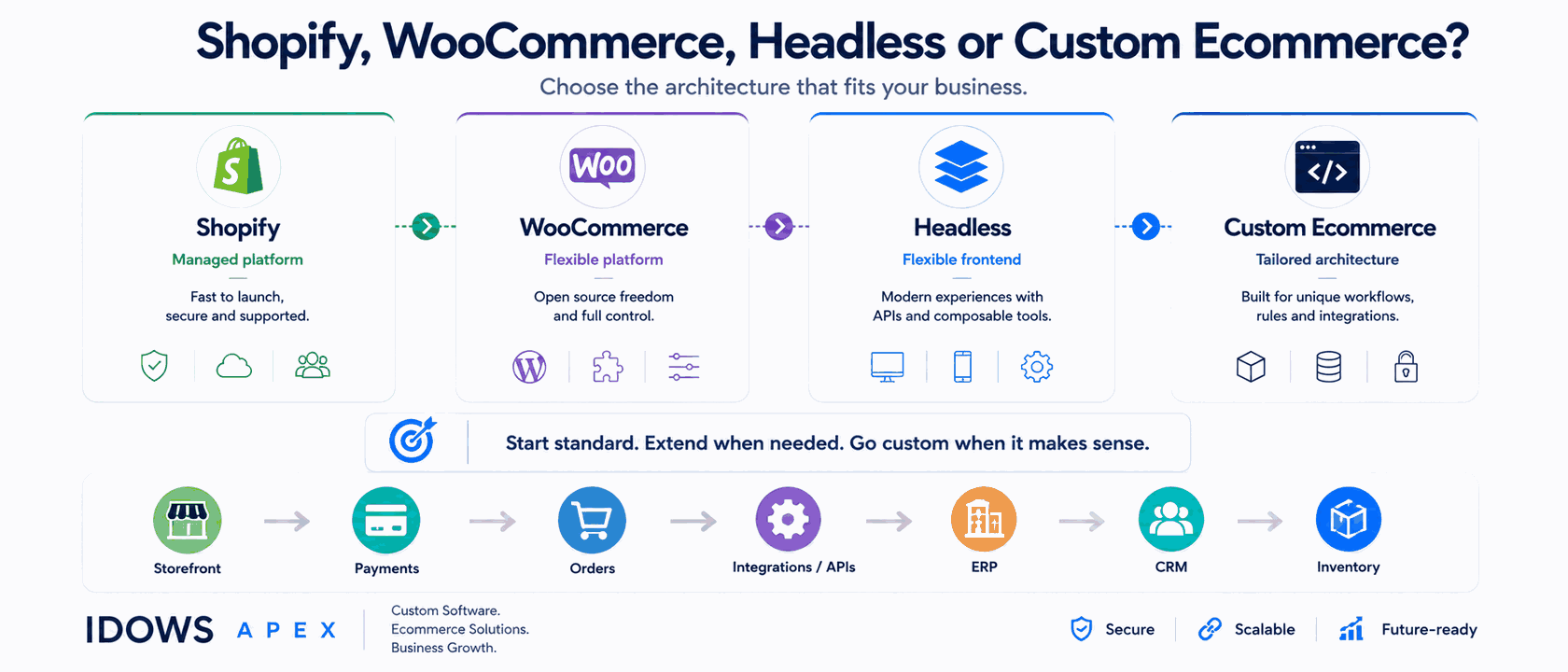
When Shopify or WooCommerce is enough, when to extend them, and when complex pricing, workflow or integration rules justify a custom ecommerce platform.
Related work that often sits alongside this one in the same engagement.